Paver
 1 timber
 1 clay
Extend your connected route. Supply: 15 pavers.
 Settlers3D
LEARN THE ISLAND
Small island. Big possibilities.
Roll, trade, and build your way to 10 victory points. Learn the rules of our free browser strategy game with examples you can actually try.
No download · No account required · 2–6 players
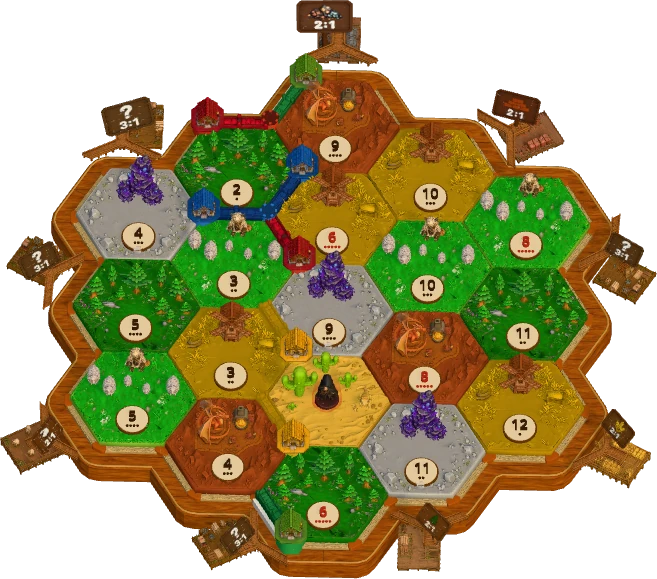
THE GAME IN 24 SECONDS
See a roll become resources, a paver become a route, and a village grow into a castle.
This silent animation uses pictures captured from the actual game tiles, with teaching overlays. Try the interactive examples below to explore each action.
THE GOAL
Reach 10 victory points on your turn. A village is worth 1 point; upgrading it to a castle makes that building worth 2 points total. Each award is worth 2 while you hold it, and each Crown Relic card is worth 1.
BUILD A WINNING SCORE
Add buildings, then see how awards can bring ten points within reach.
8 more to win on your turn.
2 buildings · 0 award points
YOUR TURN. YOUR TEN. YOUR WIN.Crown Relic cards stay hidden until they can give you the win. The score builder is an example, not a saved game.
YOUR FIRST TWO SETTLEMENTS
Players roll to determine who starts. Place one village and an adjoining paver in turn order, then place a second pair in reverse order. Your second village gives you one card from each resource tile it touches.
FOUR-PLAYER PLACEMENT EXAMPLE
Place a village and one adjoining paver. Your starting resource cards arrive with your second village.
+1 timber +1 grain
 +1 lamb
Illustrated corner example. Your cards depend on the tiles beside your second village.
Leave a corner free. A village cannot occupy a corner next to another village or castle, including an opponent’s. After setup, new villages must connect to your pavers.
EVERY ROLL MATTERS
At the start of your turn, roll two six-sided dice. Every tile with the matching total produces for all players with a building on it. A 7 triggers the thief instead.
6 has 5 combinations out of 36: a 13.9% chance on each roll.
Select a number to explore. The dots on game tokens show relative frequency: more dots means more ways to roll it.
7 is the most likely total (6 out of 36). Among resource-producing totals, 6 and 8 are most likely. Each roll is independent; a number is never “due.”
FROM ISLAND TO HAND
A village collects 1 resource from each matching adjacent tile; a castle collects 2. The Barrens tile produces nothing. A tile occupied by the thief produces nothing, even when its number rolls.
TRY THE PRODUCTION RULE
Blue has a village touching the Timberland (6). Choose a roll and watch the payout.
The gold village touches grain (8). This example assumes cards remain in the bank.
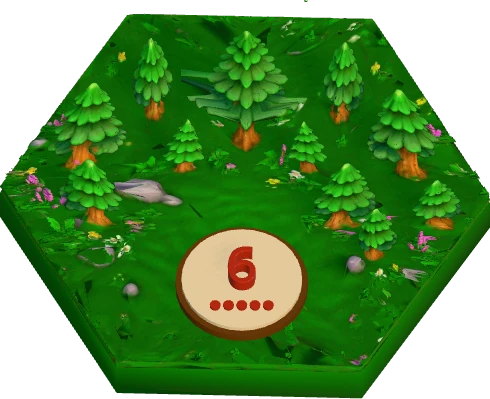
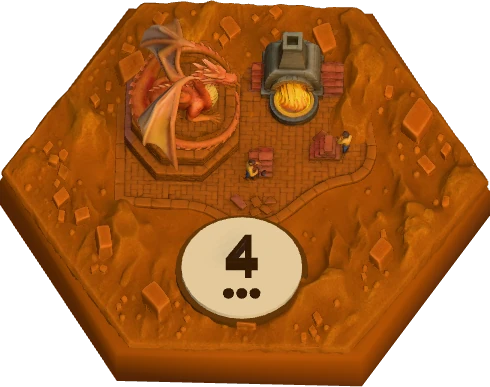
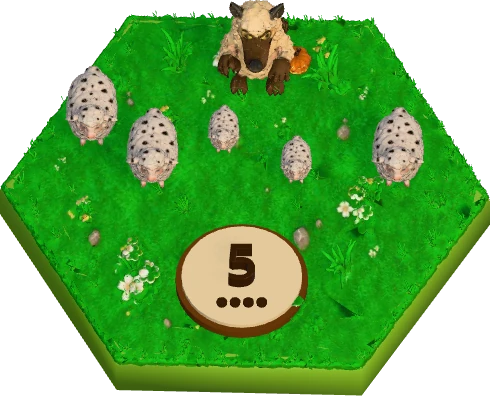
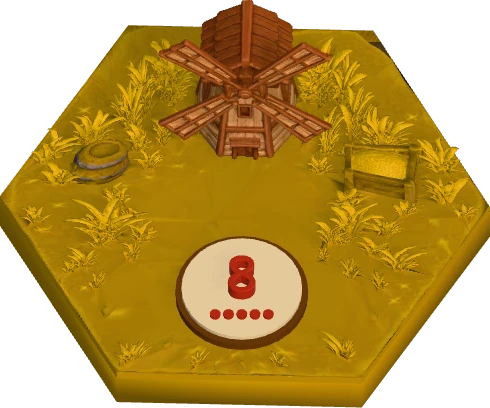
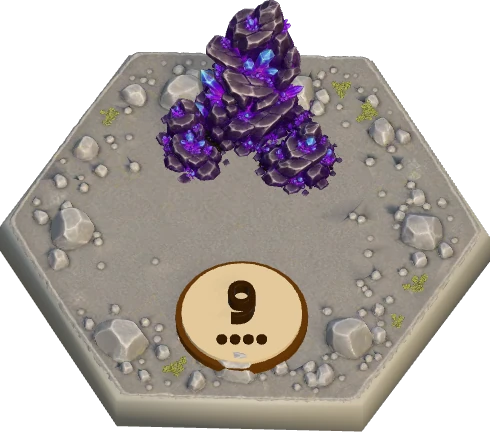
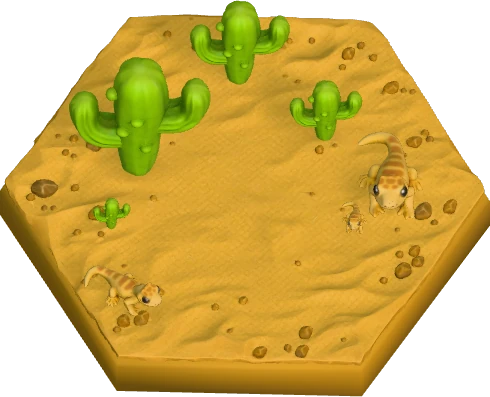
The island has 19 land tiles. Timberland produces timber, Clay Pit clay, Meadow lamb, Grain Fields grain, and Mountains iron. The bank starts with 19 of each resource. If a shortage affects several players, nobody receives that resource; if only one player is owed it, they receive what is available.
SPEND WITH A PLAN
After rolling and resolving any mandatory actions, trade resources and pay the bank to build. Pavers follow tile edges; villages sit on corners. Castles upgrade your own villages.
1 timber1 clayExtend your connected route. Supply: 15 pavers.
1 timber1 clay1 lamb1 grain1 point and one card per producing tile. Supply: 5 villages.
2 grain 3 iron
2 points total and double production. Supply: 4 castles. The village returns to your supply.
1 lamb1 grain1 ironDraw from the face-down deck. Keep your card hidden until you use or reveal it.
A castle adds one net point when it replaces a village. An opponent’s building can interrupt your route, and new pavers must obey the game’s legal connection markers.
MAKE YOUR HAND WORK HARDER
Trade with other players during your turn, or exchange matching resources with the bank. The normal bank rate is 4:1. A village or castle on a port gives you a better rate.
COMPARE BANK & PORT RATES
4 timber1 ironGive 4 timber to the bank to receive 1 iron.
A 2:1 timber port only discounts timber you give. You still need two matching timber cards, and the card you request must be available.
WHEN A SEVEN CHANGES THE PLAN
9 resource cards → discard 4, keep 5.
KEEP SOMETHING UP YOUR SLEEVE
Play at most one Sentinel or progress card per turn, including before rolling. You cannot play it on the turn you bought it. Hidden Crown Relic cards are different: reveal the points you need to win on your turn.
Move the thief to a different tile and steal one random resource from an eligible opponent there. Played Sentinels count toward Mightiest Garrison. The house-rule theft protection still applies.
Place up to two legal pavers without paying resources, subject to the paver pieces you have left.
Take any two available resources from the bank. You can choose the same resource twice if the bank has enough.
Choose a resource. All other players give you every resource card of that type from their hands.
Each is worth 1 point. Keep these hidden until they let you reach the winning total on your turn. They are not a once-per-turn action card.
BUILD SOMETHING WORTH KEEPING
Be first to build a continuous route of at least 5 pavers. A challenger needs a strictly longer route to take the award. Branches do not simply add together; opponents’ buildings can break a route.
Be first to play 3 Sentinels. A challenger needs more played Sentinels than the current holder. Sentinels still in your hand do not count.
These points move with the award. A tie does not take an award away from its current holder. A broken paver can trigger a fresh Grand Highway evaluation.
YOUR FIRST GAME IS JUST THE START
Play vs AI supports Easy, Medium, and Hard; Hard is selected by default. Local Hot Seat lets 2–6 players share one device. Play online through Quick Match or the Public Lobby, or create a private room with Play with Friends.
Games with 5 or 6 players use the same standard 19-tile island as a house rule; this is not an expanded-board extension. Online games use a turn timer. After a game, Match Stats shows how everyone did.
A FEW THINGS PEOPLE ASK
Yes. Play in your browser with no download. You can play against AI or locally without an account; online play can sign you in as a guest. A profile is optional.
Play vs AI and Local Hot Seat support 2–6 players. Games with 5 or 6 players use the standard island as a house rule.
Yes. Choose Play with Friends to create a private room and share the invite link. Quick Match and the Public Lobby connect you with other players.
A castle is worth 2 points total. It replaces a 1-point village, so the upgrade increases your score by 1.
Roll first and resolve mandatory actions before trading and building. You may play one eligible development action card before your roll.
Yes. More than 7 resource cards triggers a discard. With 8 cards, discard 4. With 9 cards, discard 4. Fortune Cards do not count.
No. Our house rule keeps the thief off tiles next to a player until they build beyond their two starting villages and pavers, upgrade to a castle, or buy a Fortune Card. They still discard when required.
A modern browser with WebGL. A desktop or laptop gives the best experience. This guide works without loading the 3D game.
YOU KNOW ENOUGH TO BEGIN
The best way to learn the rest is to make your first move.
Play Settlers3D free